
The accounting option
Your books, where your documents already are.
Between the software where you manage and the one where you post entries there is always a manual step — and that is where the two versions of the truth part company. Three frameworks, one database.
XAF 153,000 a year on the SME plan · included on the Practice plan
Three accounting frameworks
An installation keeps one, shared by all its entities. It follows from the currency of the first entity and is fixed the first time the books are opened: the accounts laid down are never removed.
Revised SYSCOHADA
The full AUDCIF chart, classes 1 to 9, around 1,400 accounts. Balance sheet, income statement with its intermediate balances, cash flow statement, notes and the filing pack.
Plano Geral de Contabilidade
The chart of decree no. 82/2001, 231 accounts at the levels a small business needs, labelled in Portuguese, with IVA at 14 %. Balanço, demonstração de resultados, fluxos de caixa, notas das imobilizações. Here income sits in class 6 and expenses in class 7 — the reverse of SYSCOHADA.
IFRS for SMEs
Rwanda imposes no chart of accounts: Konseo proposes one of 163 accounts, in English, numbered the way the region expects, with VAT at 18 %. Statement of financial position, profit or loss, cash flows and notes.



The Angolan and Rwandan charts are reviewed by a professional in the country before the first client — a member of ICPAR in Rwanda, a contabilista certificado registered with the OCPCA in Angola. We would rather write it here than let you find out when your books are opened.
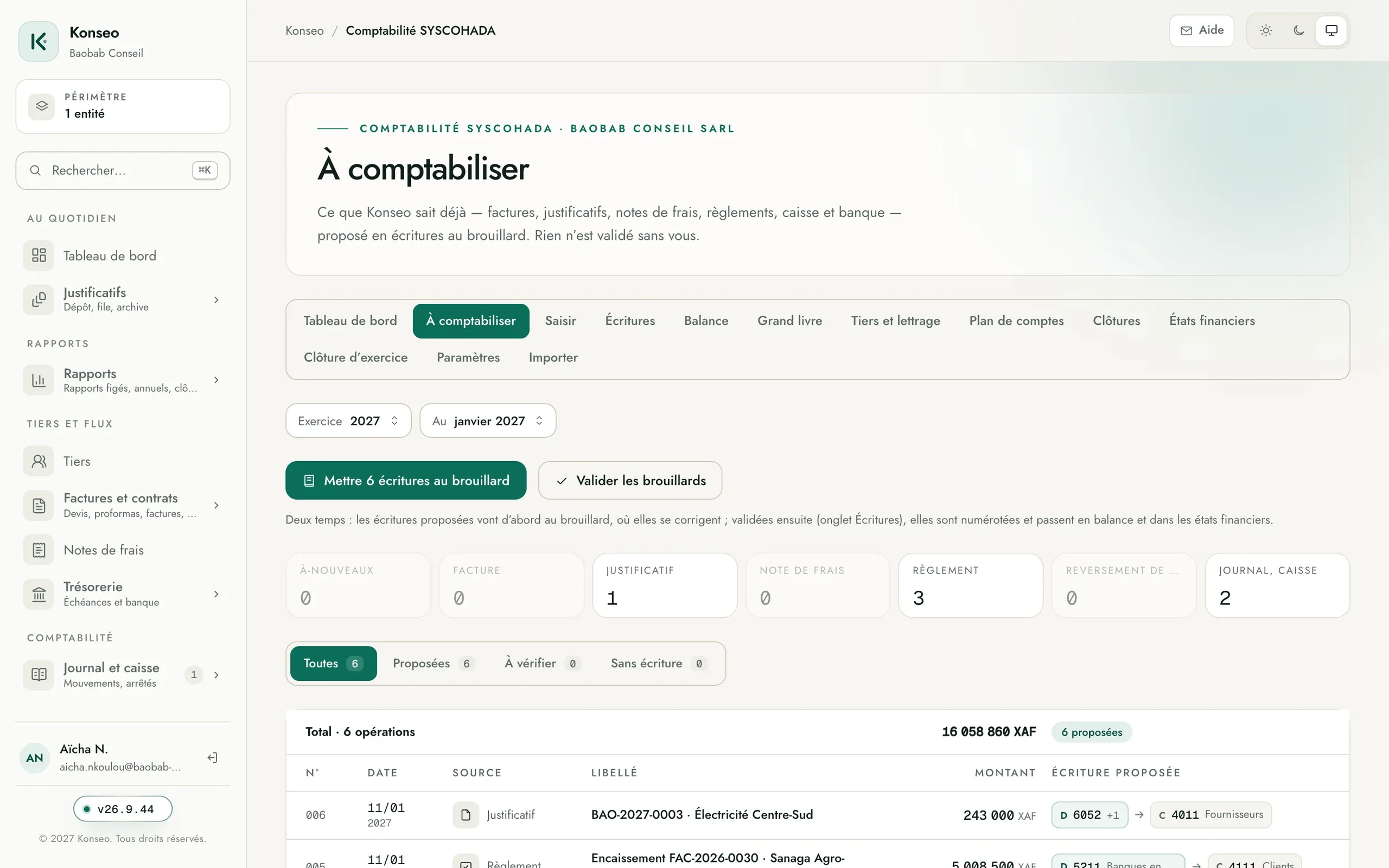
The “to be posted” screen
For the period you choose, Konseo lists what accounting has not seen yet, with the entry it proposes for each. Your accountant reads it back, corrects where needed, and drafts the whole batch in one move. Nothing is validated without them.
- Invoice issued
- Customer debited; sales and output VAT credited. A credit note: the reverse.
- Recorded receipt
- The expense on the category’s account, against the supplier.
- Approved expense claim
- One charge per category, against the amount owed to the person.
- Payment, cash movement
- Bank, petty cash or mobile money against the party concerned.
A source is never proposed twice, and it is the database that holds that. The account comes from the category, mapped onto the chart. A partner’s personal expense goes to their current account — and if they paid it themselves, it produces no entry at all: the rule almost every current-account spreadsheet is missing.
The chart and the journals
The chart of the framework in force, laid down in full on first opening. Your own subdivisions go under an existing account: a subdivided account takes no entries, an account carrying entries is not subdivided — the AUDCIF rule, applied everywhere. Six journals per entity.
Draft first, then final
An entry is born as a draft, where it can be reworked and may even stay unbalanced. Once validated it is checked, numbered without gaps per journal and per financial year, then frozen. It is neither edited nor deleted: it is reversed, and both stories stay readable — which is exactly what an auditor comes to check.
Trial balance, ledger, matching
A six-column trial balance, the general ledger of an account with its running balance, the party balance with its unmatched lines. Matching brings the invoice, its credit note and its payment under one letter, and can be undone. Automatic matching handles exact pairs, then a party’s remainder if it cancels out entirely — never an approximation.
Closing, opening balances, statements
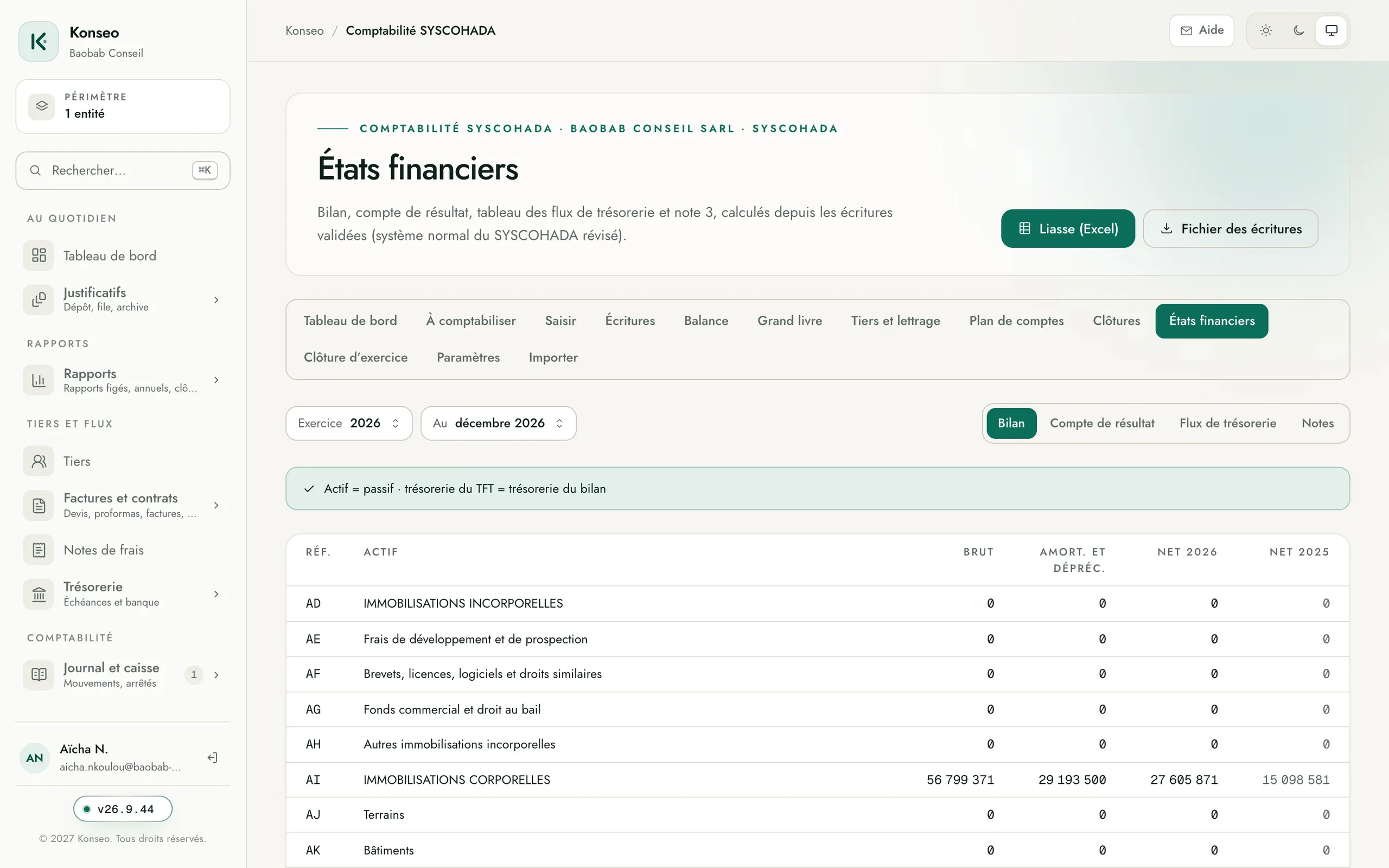
A financial year closes when its twelve months are closed. The result is struck, the opening balances posted on the first day of the next year, party by party. Then the balance sheet against the previous year, the income statement with its intermediate balances, the cash flow statement, the notes, the spreadsheet pack and the entry file for an auditor.
Three checks at the top, always
Assets equal liabilities, the cash flow check, and the list of accounts filed under no heading. You do not discover a discrepancy rereading the PDF the night before the meeting.
Eleven refusals held by the database
Rewriting a validated entry, creating one without a draft, validating an imbalance, matching twice, writing into a closed month, reopening a closed year: the database refuses, and a hand-written query gets no further.
Your books stay readable
If the licence lapses, the accounts remain readable. The AUDCIF requires books to be kept for ten years: we do not hold a client’s books hostage, and we do not destroy them either. Nothing more is written to them until renewal, that is all.
Arriving with your past
Nobody starts a set of books from nothing on 1 January. An opening trial balance or an entry export is imported from a spreadsheet: columns are recognised by their heading, in French, English or Portuguese, in any order. A preview shows the lines read, the entries rebuilt and the errors one by one — nothing is imported while one remains, and everything arrives as a draft.
A demonstration on your own documents.
Bring three receipts and a live project: we put them through in front of you. We reply within 48 h.